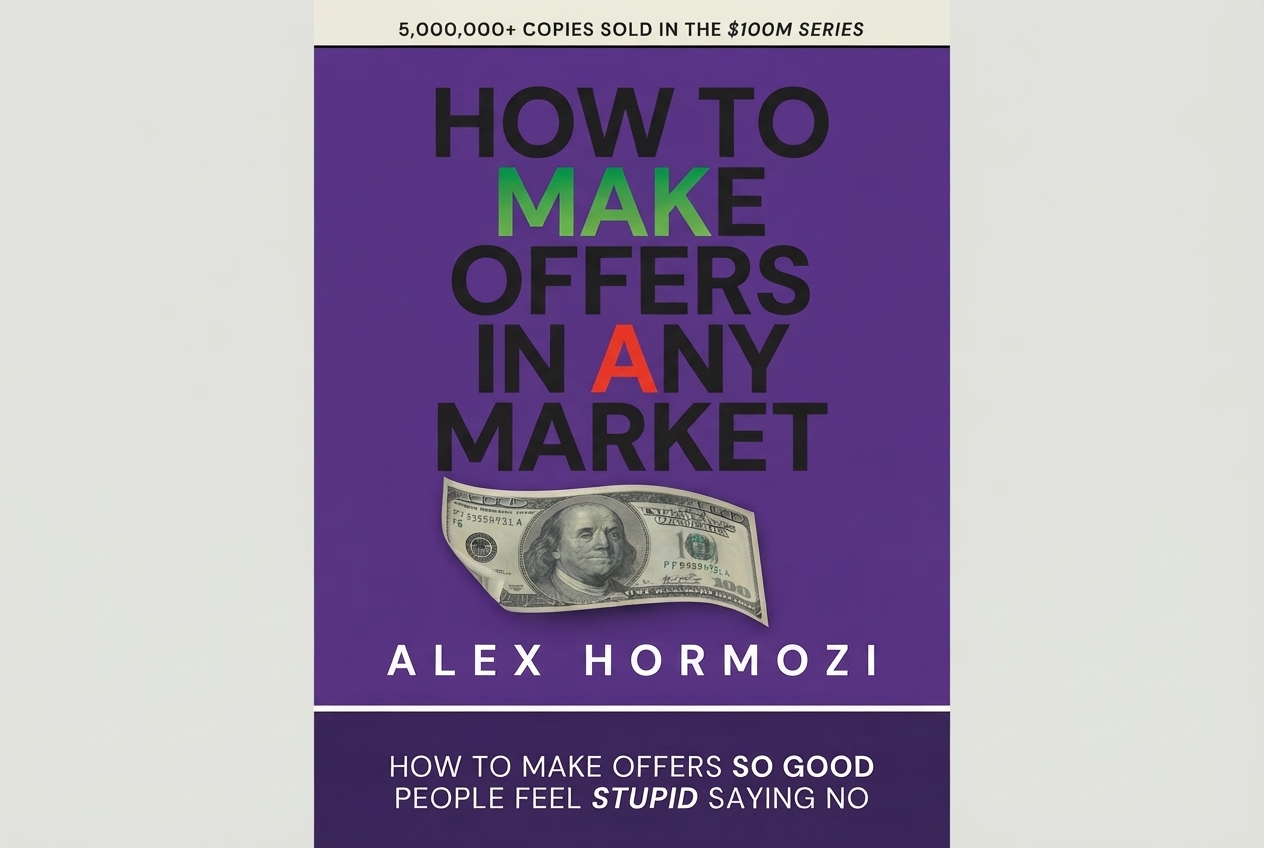
If you are trying to build a business, sell a service, launch a product, or simply understand why some businesses can charge much more than their competitors, $100M Offers: How to Make Offers So Good People Feel Stupid Saying No is a book worth knowing about.
Written by entrepreneur and investor Alex Hormozi, the book focuses on one fundamental business question:
How can you make your offer so valuable that customers see the value instead of focusing only on the price?
Rather than presenting marketing as a collection of complicated tricks, Hormozi builds his approach around the idea of creating a stronger value proposition—one that addresses a specific customer’s problem and makes the desired outcome feel more achievable.
What Is $100M Offers About?
Published in 2021, $100M Offers is a business and marketing book centered on product positioning, pricing, value creation, and offer design. Google Books lists the book at 162 pages.
The central concept is what Hormozi calls a “Grand Slam Offer.”
In simple terms, instead of selling a generic service that looks similar to dozens of competing offers, you structure your product or service around:
- A clearly defined customer
- A painful or important problem
- A desirable outcome
- Strong perceived value
- Appropriate pricing
- Bonuses or additional value where useful
- Risk reduction through an appropriate guarantee
- Clear positioning and naming
The objective isn’t simply to make something cheaper.
It is to make the overall value proposition more compelling and easier to understand.
Why Is This Book Popular?
One reason the book has attracted so much attention is that it approaches selling from the perspective of value rather than simply persuasion.
The official Acquisition.com website describes $100M Offers as the first book in Hormozi’s $100M series, followed by $100M Leads and $100M Money Models.
Amazon’s international listing also shows strong reader interest, including a 4.9-star rating based on thousands of ratings on the listing available there.
That doesn’t mean the book’s strategies will automatically produce a particular income level. Business results depend on factors such as the market, product quality, execution, customer demand, competition, and the individual business.
But the framework can provide a useful way to think more systematically about an offer.
The Main Idea: Don’t Just Sell a Product
Imagine two freelancers offering the same basic service.
Freelancer A
“I provide lead generation services.”
Freelancer B
“I help B2B service companies build targeted prospect lists with verified business information so their sales team can spend less time researching and more time contacting potential customers.”
The second description is more specific.
It tells a potential customer:
Who is this for?
What problem does it solve?
What outcome is the customer looking for?
That is the type of thinking $100M Offers encourages.
The goal is not to use fancy words.
The goal is to make the offer easier for the right customer to understand and evaluate.
The Value Equation
One of the most useful concepts associated with the book is Hormozi’s Value Equation.
At a high level, perceived value increases when customers believe they can achieve a desirable result, particularly when they expect:
- A better outcome
- Greater certainty
- Less waiting
- Less effort and sacrifice
This gives entrepreneurs a useful framework for improving an existing offer.
For example, suppose someone sells an online Excel course.
Instead of simply saying:
“Learn Microsoft Excel.”
The creator could make the offer more specific:
“Learn the Excel skills commonly used in everyday office work through practical lessons and real-world exercises.”
The second version communicates a clearer purpose.
Four Questions to Improve Almost Any Offer
When creating or reviewing an offer, ask yourself these questions.
1. What result does the customer really want?
Customers usually aren’t buying the product itself.
They are buying what they hope the product will help them achieve.
Someone purchasing accounting software may actually want:
- Less manual work
- Better financial organization
- Fewer mistakes
- Easier reporting
Understanding the desired outcome helps you communicate the offer more effectively.
2. How difficult does the solution feel?
If customers believe a solution will require enormous effort, they may hesitate.
This is why good products often focus on making the process easier.
For example, a productivity tool might provide templates, automation, tutorials, and integrations rather than simply giving customers another complicated dashboard.
3. How long will customers need to wait?
People naturally value solutions that can help them move toward their desired outcome sooner.
However, this doesn’t mean making unrealistic promises.
A strong offer should communicate a realistic process rather than guaranteeing results that the seller cannot control.
4. How confident is the customer?
Uncertainty is one of the biggest obstacles to purchasing.
Customers may wonder:
Will this work for someone like me?
Is it worth the money?
What happens if I don’t like it?
Clear demonstrations, useful educational content, testimonials from legitimate customers, transparent terms, and appropriate guarantees can help reduce uncertainty.
Pricing: Why Cheap Isn’t Always Better
One of the interesting lessons from $100M Offers is that competing primarily on price can be difficult.
If your only advantage is being cheaper, another competitor can potentially offer something even cheaper.
Instead, businesses can compete through value differentiation.
For example:
Basic offer
- One consultation
- Generic advice
- No follow-up
Enhanced offer
- Initial consultation
- Personalized action plan
- Supporting resources
- Follow-up session
- Clear deliverables
The second offer may justify a higher price because the customer is receiving a different overall package.
The key is that additional value should be useful, not simply added for the sake of making the offer look bigger.
Bonuses: More Isn’t Always Better
Hormozi also discusses using bonuses to increase the perceived value of an offer.
For example, a course might include:
- Templates
- Checklists
- Worksheets
- Example files
- Additional tutorials
But there is an important lesson here:
A bonus should solve another obstacle.
If the bonus doesn’t help the customer achieve the desired result, adding it may simply create clutter.
Guarantees and Risk Reduction
Another important topic is guarantees.
A guarantee can reduce the customer’s perceived risk, but it should be realistic and compatible with the product.
For example, a software company might offer a money-back period under clearly defined terms.
However, businesses should avoid making promises about outcomes they cannot control.
A guarantee isn’t a substitute for product quality.
It is a way of communicating confidence while giving customers appropriate protection.
Who Should Read $100M Offers?
I think the book is particularly relevant to people involved in:
Entrepreneurs
If you’re building a business, the book can help you think more carefully about what you’re actually selling.
Freelancers
Freelancers often sell services that look similar to hundreds of competitors.
Learning how to package and position those services can help make the offer clearer.
Digital Marketers
Marketers can use the concepts to analyze why one offer may generate more interest than another.
Coaches and Consultants
If your business depends on selling expertise, understanding customer outcomes and perceived value is especially important.
SaaS Founders
Software companies can also apply the concepts to pricing, packaging, onboarding, and positioning.
Affiliate Marketers
Affiliate marketers can use the framework when evaluating products.
Instead of asking only:
“Does this product have an affiliate program?”
you can also ask:
“Does this product solve a meaningful problem, and is there a clear reason someone would want to buy it?”
That is a much more useful question.
What I Like About the Book
There are several reasons the book stands out.
Practical Rather Than Purely Theoretical
The framework is designed around applying concepts to actual offers.
Easy-to-Understand Business Concepts
The writing generally focuses on straightforward business ideas rather than complicated academic terminology.
Useful for Service Businesses
The concepts can be adapted to consulting, freelancing, agencies, coaching, and other service businesses.
Strong Focus on Customer Value
The book repeatedly brings attention back to the customer’s desired outcome rather than simply the seller’s product.
What You Should Keep in Mind
This isn’t a magic formula for becoming wealthy.
That’s important.
Reading $100M Offers won’t automatically generate customers, sales, or affiliate commissions.
You still need:
- A real market
- A useful product
- Customer research
- Good marketing
- Strong execution
- Customer service
- Consistent testing
Some examples and business claims associated with entrepreneurial books are based on the author’s own experience and shouldn’t automatically be interpreted as guarantees for every reader.
The most useful approach is to treat the book as a framework for thinking, then test the ideas against your own business.
$100M Offers vs. Simply Lowering Your Price
Here’s a simple example.
Suppose three freelancers provide similar services.
| Freelancer | Basic Positioning |
|---|---|
| A | Low price |
| B | Average price |
| C | Specific problem + defined deliverables + additional value |
The third freelancer doesn’t necessarily need to be the cheapest.
Instead, the customer needs to understand why the offer is different and what they are actually getting.
This is one of the most important lessons I took from the book:
The goal isn’t always to lower the price. The goal is to improve the value proposition.
Is $100M Offers Worth Reading?
If you’re interested in entrepreneurship, sales, freelancing, marketing, consulting, or online business, $100M Offers provides a practical framework for thinking about how products and services are packaged and presented.
It is especially useful if you currently find yourself saying:
“My competitors offer almost the same thing.”
or
“Customers keep asking for discounts.”
or
“People don’t understand the value of my service.”
The book won’t solve those problems automatically, but it can give you a structured way to examine them.
Where to Buy $100M Offers
You can check the current Amazon listing for $100M Offers: How to Make Offers So Good People Feel Stupid Saying No by Alex Hormozi to see the latest availability, editions, and current price.
👉 Check the book on Amazon:
$100M Offers by Alex Hormozi on Amazon
Prices and availability can change, so check Amazon for the current information before purchasing.
Final Thoughts
A successful business isn’t simply about having a good product.
You also need to communicate why that product matters to a particular customer.
That’s where $100M Offers becomes interesting.
Alex Hormozi’s framework encourages entrepreneurs to move away from generic products and services and instead think about the customer, the desired outcome, perceived value, pricing, risk, and the overall structure of the offer.
For freelancers, entrepreneurs, marketers, consultants, and online business owners, those are valuable concepts to understand.
If you’re currently trying to improve your own service or product offer, this book can give you plenty of ideas to experiment with.
The biggest takeaway isn’t “sell harder.”
It’s:
Create something genuinely valuable, understand who needs it, and communicate that value clearly.