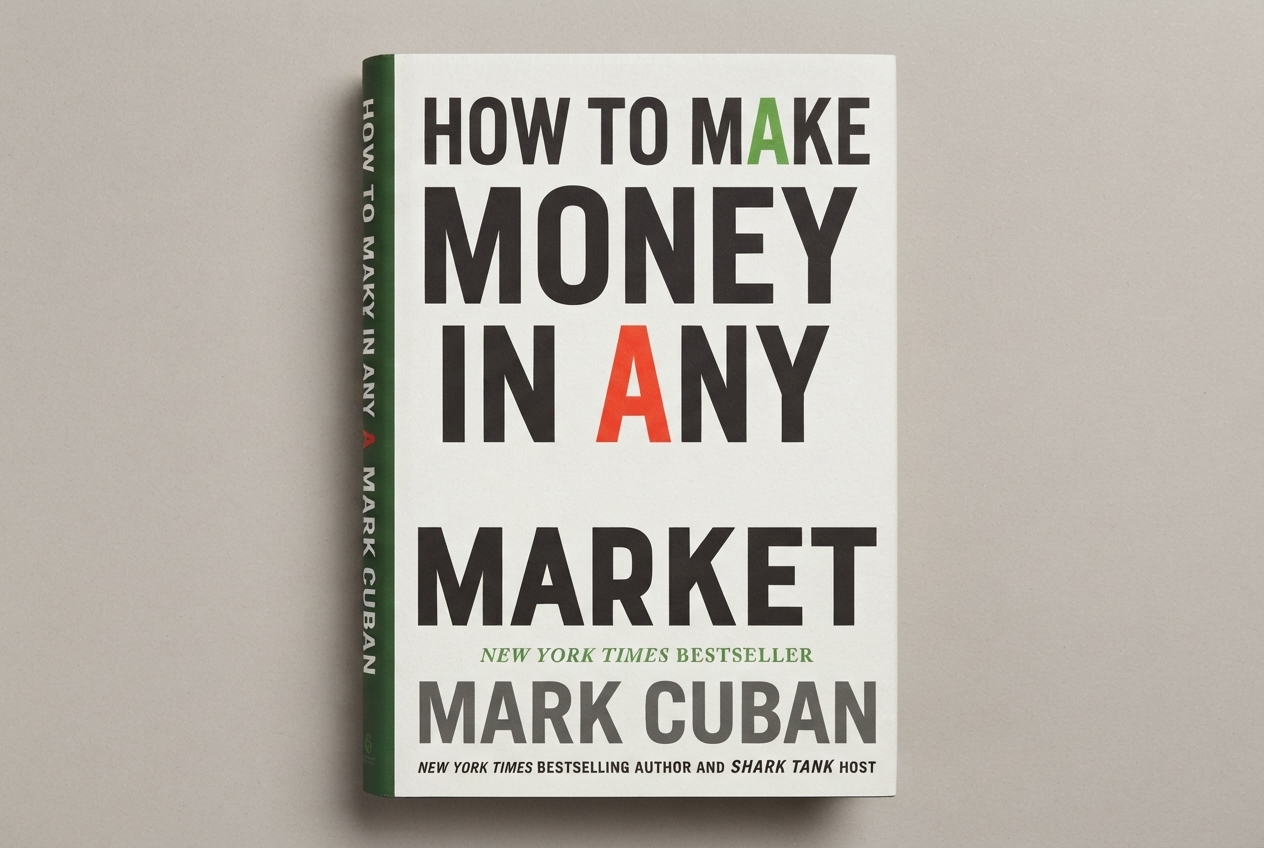
If you have ever felt that the stock market is too complicated, unpredictable, or intimidating, How to Make Money in Any Market by Jim Cramer may be an interesting book to add to your reading list.
Published by Simon & Schuster in September 2025, this 320-page book is written for individual investors who want to understand the stock market better and develop a more structured approach to researching companies and stocks.
Jim Cramer is widely known for his work on CNBC, including Mad Money, Squawk on the Street, and CNBC’s Investing Club. He also has a background as a former hedge fund manager and has written several books about investing and personal finance.
But does this book actually offer something useful for ordinary readers?
Let’s take a closer look.
📚 Book at a Glance
| Feature | Details |
|---|---|
| Book Title | How to Make Money in Any Market |
| Author | Jim Cramer |
| Publisher | Simon & Schuster |
| Publication Date | September 30, 2025 |
| ISBN-10 | 1668088649 |
| ISBN-13 | 9781668088647 |
| Length | 320 pages |
| Main Topic | Stock Market & Investing |
| Format | Hardcover |
| Audience | Individual investors |
The bibliographic information is independently listed by Google Books and library catalogs.
What Is How to Make Money in Any Market About?
The central idea of the book is relatively straightforward: investors should learn how the market works, understand businesses, and develop a process for identifying potential growth and income stocks rather than simply reacting emotionally to market movements.
Cramer approaches the subject from the perspective of an experienced market commentator and former hedge fund manager. The book is designed to make investing concepts more accessible to everyday investors rather than presenting them as an academic finance textbook.
One interesting aspect is that the book does not focus exclusively on finding the next hot stock. Instead, its contents cover topics such as researching companies, comparing stocks, understanding valuations, reading financial statements, and thinking about different types of stocks.
That makes the book broader than its attention-grabbing title might initially suggest.
What Will You Learn From the Book?
According to the published table of contents, the book is divided into several major areas.
1. Understanding Why You Invest
The first section looks at fundamental questions surrounding stock-market investing.
It discusses topics including:
- Why invest at all?
- Index funds
- Individual stocks
- Finding an investment edge
- Understanding notable companies such as Nvidia
- Becoming more comfortable with investing
This section is useful for readers who want to understand the basic reasoning behind different investment approaches.
2. Building a Stock Portfolio
The second major section focuses more directly on constructing and researching a portfolio.
Topics listed in the library catalog include:
- Building a portfolio
- Narrowing down investment choices
- Comparing one stock with another
- Understanding what a stock may be worth
- Understanding why stocks move
- Choosing stocks
- Researching companies
These are important concepts because buying a stock is only one part of investing. Understanding what you own and why you own it can be equally important.
3. Reading Financial Statements
One of the more practical elements of the book is its focus on company financial information.
The contents include sections on:
- Balance sheets
- Income statements
- Conference calls
- Company research
For a beginner, financial statements can look intimidating at first. A book that explains what to look for can potentially make the process less confusing.
However, readers should still remember that financial analysis requires practice, and no single book can turn someone into an expert investor overnight.
Growth Stocks and Income Stocks
Another important theme is the distinction between growth-oriented stocks and income-producing stocks.
Growth stocks are generally associated with companies where investors expect earnings or business expansion to increase over time.
Income-oriented investments, meanwhile, may appeal to investors looking for companies that can provide income, often through dividends.
The book discusses both categories and also looks at companies and sectors that Cramer considers important examples. The published contents include chapters on “hero stocks,” winning sectors, recent notable companies, and income producers with growth potential.
This makes the book potentially useful for readers who want to learn how different investment characteristics can fit into a broader portfolio.
What Makes This Book Interesting?
A Practical Rather Than Academic Approach
One of the book’s strongest characteristics is its practical orientation.
Rather than presenting investing entirely through complicated financial theory, Cramer attempts to explain market concepts for individual investors.
That approach can make the material more approachable for someone who is just beginning to learn about stocks.
Focus on Research
The book places considerable emphasis on researching companies.
That is important because successful investing isn’t simply about hearing a stock tip and buying immediately.
Understanding a company’s business, financial position, earnings, management commentary, and industry can provide much more context.
Real-World Market Perspective
Cramer’s long career in finance and financial media gives the book a real-world perspective.
He has spent years discussing market movements, companies, sectors, earnings, and investor behavior publicly. His experience is one reason the book is likely to appeal to readers who prefer practical market commentary over highly technical textbooks.
Who Should Read How to Make Money in Any Market?
This book may be worth considering if you are:
- New to stock-market investing
- Interested in learning how to research companies
- Trying to understand growth and income stocks
- Looking for a beginner-friendly investing book
- Interested in financial statements
- Curious about how experienced market commentators analyze stocks
- Looking for a structured introduction to stock research
It may be less suitable if you are looking specifically for advanced quantitative finance, professional-level portfolio management, or a purely academic treatment of investing.
What I Like About the Book
There are several things that stand out.
First, accessibility. The book is aimed at individual investors rather than finance professionals.
Second, practical topics. Researching stocks, comparing companies, reading financial statements, and understanding valuation are more useful long-term skills than simply following market headlines.
Third, broad coverage. The book touches on index funds, individual stocks, portfolio construction, company research, growth stocks, income stocks, sectors, and common investment mistakes.
Fourth, the author’s experience. Cramer’s background in investing and financial media provides a perspective that many beginner readers may find engaging.
Things to Keep in Mind
No investing book should be treated as a guaranteed formula for making money.
The title How to Make Money in Any Market is attention-grabbing, but actual investment results depend on many factors, including market conditions, the companies selected, valuation, diversification, risk tolerance, time horizon, and individual circumstances.
Also, because the book was published in 2025, specific companies or market examples discussed in it should not automatically be interpreted as current recommendations.
The stock market changes continuously. Information that is useful for understanding a company today can become outdated later.
For that reason, I would view this book primarily as an educational resource for learning how to think about and research investments, rather than as a promise of profits.
Is How to Make Money in Any Market Worth Reading?
For readers interested in learning more about stock-market investing, the book offers a fairly broad introduction to the subject.
Its combination of portfolio construction, stock research, valuation, financial statements, growth stocks, income stocks, and market psychology makes it more comprehensive than a simple “stock tips” book.
The biggest potential benefit is not learning one magic formula.
Instead, it is learning to ask better questions:
What does this company actually do?
How is the company performing financially?
What could make the business grow?
What risks could hurt it?
How does this stock compare with alternatives?
Those questions can help readers develop a more thoughtful approach to investing.
Final Thoughts
How to Make Money in Any Market by Jim Cramer is a 2025 investing book aimed at individual investors who want to become more comfortable with the stock market and learn a practical framework for researching companies.
It covers a wide range of subjects, from index funds and individual stocks to portfolio construction, valuation, financial statements, company research, growth stocks, income-producing companies, sectors, and investment mistakes.
I would not treat the book’s title as a guarantee that readers can literally make money in every market condition. Instead, its value is in learning more about the research and decision-making process behind stock investing.
If you’re building your investing knowledge and prefer practical explanations over highly technical financial textbooks, this book could be a useful addition to your reading list.
Where Can You Get the Book?
You can check the current Amazon listing, available formats, and current price here:
Check How to Make Money in Any Market on Amazon
Affiliate Disclosure: This article may contain affiliate links. If you purchase through one of these links, we may receive a small commission at no additional cost to you. This helps support the website and allows us to continue publishing useful product reviews and buying guides.
Important: This article is for educational and informational purposes only. It is not financial, investment, or tax advice. Always do your own research and consider consulting a qualified financial professional before making investment decisions.